That “Quick Status Update” Call Is Costing You a Fortune
 17. March 2026
- By Berias
 17. March 2026
 Share
Share


“Where is my shipment?”
On the surface, it is an innocent question. For most freight brokerages, it is also one of the biggest productivity killers in the entire business.
Every status call seems small. A client calls, you answer, you check, you call back. But inside your operation, that “quick update” quietly drains time, focus, and margin all day long.
What Really Happens Behind One Status Call
Think about what happens when a customer asks for an ETA.
Your dispatcher stops what they are doing and breaks focus. They switch context from planning or exception handling to this one request. Then they call or message the carrier, wait for a response, and often chase if the answer does not come immediately. Once they have something, they call or email the customer back, update a system or spreadsheet, and try to find their way back to what they were doing before.
On paper, that is a “two-minute” call. In reality, by the time you count the interruptions, the waiting, the context switches, and the follow-up, you have easily burned 10-15 minutes of your most valuable operations time. And this does not happen once. It repeats dozens of times per day, across multiple people.
It feels like good customer service. In practice, it is a leak in your capacity.
The Hidden Productivity Tax in Your Brokerage
The real cost of these calls is not the phone time. It is everything they interrupt.
Dispatchers and operations teams work best in flow: planning loads, managing exceptions, proactively optimizing capacity. Every incoming “Where is my shipment?” pulls them out of that flow and throws them into reactive mode. Over a full day, the result is:
– Fewer loads handled per dispatcher.
– More errors, because people are constantly switching context.
– Slower response on real problems, because the team is drowning in micro-requests that a system could handle.
Industry data backs this up: companies that automate tracking and status communication see measurable reductions in phone time and increases in throughput per dispatcher. AI-driven and automated tracking tools can cut manual check calls and status chasing by 30–60%, freeing capacity to move more freight instead of answering the same question over and over.
This is not a people problem. It is a systems problem.
Your Clients Want Visibility, Not Phone Time
From the customer’s perspective, frequent status calls are not a sign that they enjoy talking to your team. They are a sign that your system is not giving them what they need.
Shippers and consignees want:
– Real-time visibility on where their freight is.
– Proactive alerts when something is delayed.
– Confidence that they do not have to chase you for basic information.
If your only answer to “Where is my shipment?” is “Call us and we will check,” you are forcing them into a manual process they did not ask for. The result is predictable: more calls, more emails, more interruptions, and more stress on both sides.
The good news: modern tracking, TMS, and notification tools make it possible to shift from reactive phone support to proactive, automated communication, without needing an enterprise budget.
From Reactive Calls to Proactive Systems
Fixing this does not start with buying another tool. It starts with the process.
First, you need clarity on your current status-update flow: how location data enters your systems, who sees it, how often it is updated, and when customers are informed. Most brokerages discover that data exists, but is fragmented across TMS, carrier portals, spreadsheets, emails, and chat. So people do not trust any single source and keep calling “just to be sure”.
Once you map the process, the path to automation becomes clearer:
– Real-time tracking: Integrate carrier GPS, ELD, or tracking apps so load status updates automatically without manual check calls.
– Automated notifications: Configure rules so customers receive milestone updates and “running late” alerts automatically by email, portal, or even SMS.
– Central source of truth: Provide a portal or share links where customers can check status themselves, instead of reaching for the phone.
When this is in place, status calls do not disappear completely, but the volume drops dramatically. Your team deals with true exceptions and complex situations, not routine “Where is my shipment?” requests all day long.
For many brokers, that shift alone can increase the number of clean loads handled per dispatcher per week and free up hours of productive time.
Imagine a Different Kind of Day in Operations
Picture a day where your dispatcher is not constantly reacting to incoming calls.
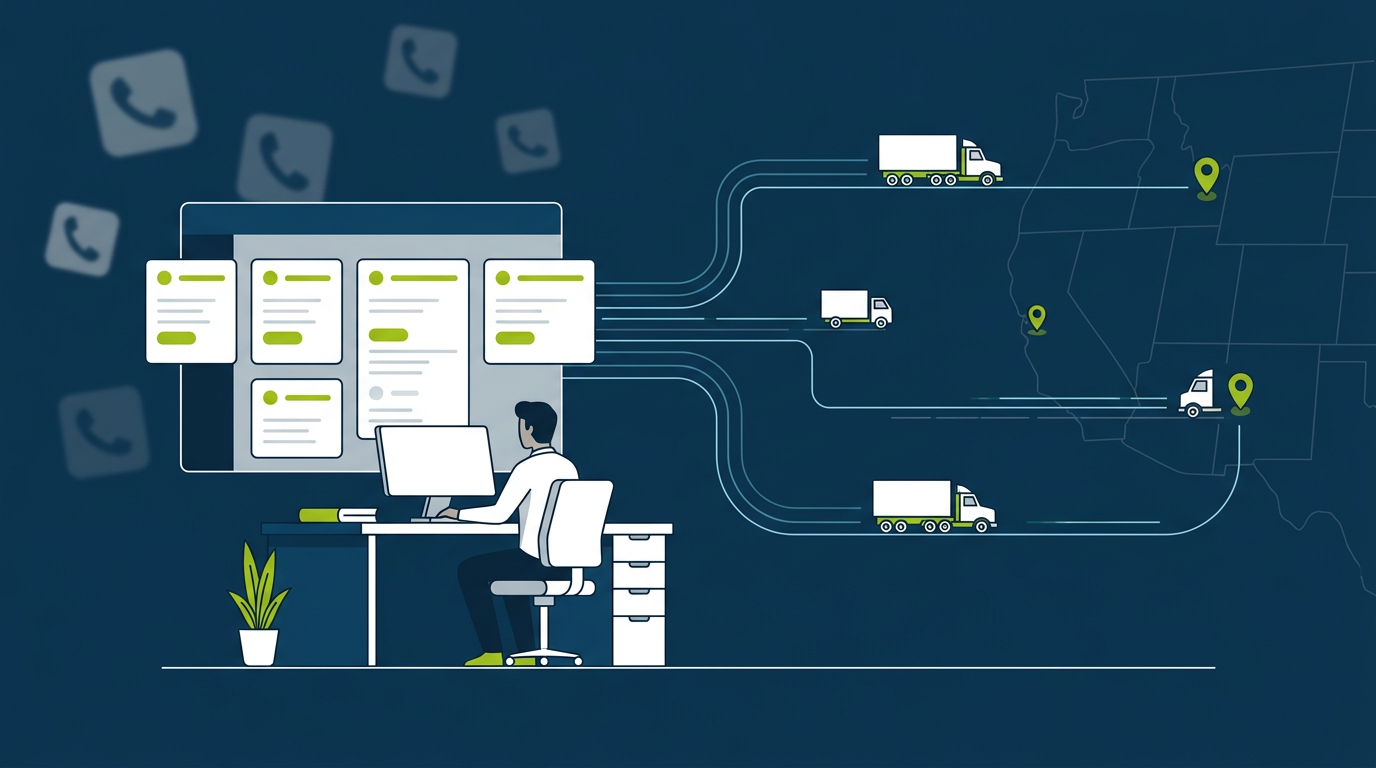
Instead of being chained to the phone, they are planning capacity, identifying potential issues before they explode, and talking to customers about new opportunities rather than just ETAs. Customers see live status in a portal or receive automated updates when a truck leaves, hits a geofence, or is trending late.
The phone still rings, but that time is now used for real problem-solving and relationship building. The noise is gone. The work feels more controlled and less chaotic.
This is not a fantasy. It is what happens when you turn “status updates” from a manual habit into a designed, automated process.
How BERIAS Helps You Eliminate Status-Call Chaos
At BERIAS, we work at the intersection of process, technology, and AI automation for SMEs, including freight brokers and logistics operators. Our focus is to help you redesign workflows like tracking and status communication so your team spends less time chasing updates and more time moving freight.
In a typical engagement, we:
– Map your current tracking and communication process and quantify where time is lost.
– Design a lean, standardized status-update workflow with clear ownership and triggers.
– Identify and implement practical automation, using the tools you already have or light additional solutions, to reduce manual check calls and reactive status chasing.
The goal is simple: fewer interruptions, more throughput per dispatcher, and a better experience for your customers.
Two Fast Ways to Start: 30-Day Sprint and Adaptive Micro Consulting
You do not need a big transformation program to see results.
With a 30-day sprint, we focus on one core area, like shipment tracking and customer updates, and move from diagnosis to a concrete implementation plan. In roughly four weeks, you gain a clear picture of the current workflow, a redesigned target process, and a prioritized automation roadmap you can execute.
If you prefer a lighter format, Adaptive Micro Consulting gives you short, high-impact sessions aimed at a single problem. You bring a specific challenge, for example, “status calls are killing our productivity” and we work through it together to design practical changes and an action plan you can implement quickly.
Find the Adaptive Micro Consulting here.
Start with a 15-Minute Free Audit Call
If this feels familiar, your team stuck on the phone all day, customers constantly asking for ETAs, and dispatchers running on fumes, the first step is simply to get a clear picture.
That is why we offer a 15-minute free audit call. In this short conversation, we look at how you are currently handling tracking and customer communication, point out one or two immediate improvements, and suggest whether a 30-day sprint or a micro consulting session is the best next step for you.
No pressure, no slide decks, just a focused discussion about how to stop “quick status updates” from quietly draining your margin.
Find your 15-minute free audit call here.